
What Shapes How We Lead, Perform, and Adapt

The idea often associated with Carl Jung — that much of what shapes our lives operates beneath conscious awareness — feels increasingly relevant today.
Not only in personal growth, but in how we lead, perform, and adapt in a world that is constantly evolving.
Because much of how we communicate, make decisions, respond under pressure, and engage with others is influenced by patterns we rarely stop to notice.
The habits we repeat.The assumptions we make.The way we react when things feel uncertain.The behaviours we default to when demands increase.
Often, these patterns sit quietly in the background, shaping outcomes without us fully recognising their influence.
And that matters more than ever.
Leadership Is Shaped Long Before Decisions Are Made
Leadership is often judged by visible outcomes.
Results. Direction. Communication. Decisions.
But leadership is not only shaped in moments of action.
It is shaped beforehand — in how leaders think, regulate pressure, communicate under uncertainty, and influence the environments around them.
When awareness is missing, reactions can become automatic.
Pressure influences communication. Stress affects clarity. Assumptions replace curiosity. And over time, these behaviours shape culture, performance, and trust.
The strongest leaders are rarely those who simply know the most.
They are often the ones who understand themselves best.
Because leadership is not only about strategy.
It is about how people experience you.
Performance Is More Than Output
In high-performing environments, it is easy to confuse movement with progress.
Busy schedules, constant urgency, and nonstop decision-making can feel productive.
But sustainable performance is not built through reaction alone.
It is built through awareness.
The ability to recognise what supports focus, what drains energy, and how to operate intentionally under pressure often has more impact than working harder.
Performance coaching is not simply about doing more.
It is about understanding how you work best — and how to sustain clarity, focus, and growth over time.
Because growth without awareness often becomes exhaustion.
Adapting in an Evolving World
Technology is changing how we work, communicate, and make decisions faster than ever before.
But adaptation is not simply about adopting new tools.
It is about learning how to use them intentionally.
AI, for example, can support organisation, communication, planning, and decision-making. It can remove friction and create efficiency.
But technology alone does not improve performance.
Human awareness still shapes outcomes.
Judgment. Communication. Leadership. Critical thinking.
These remain human responsibilities.
The real opportunity is not choosing between people or technology.
It is learning how to work alongside evolving technology in a way that supports stronger human performance.
Where the Three Connect
At Monkey One, this is where our pillars come together:
Business Leadership — leading with clarity, communication, and intention.
Performance Coaching — understanding how you operate to sustain growth and perform at a higher level.
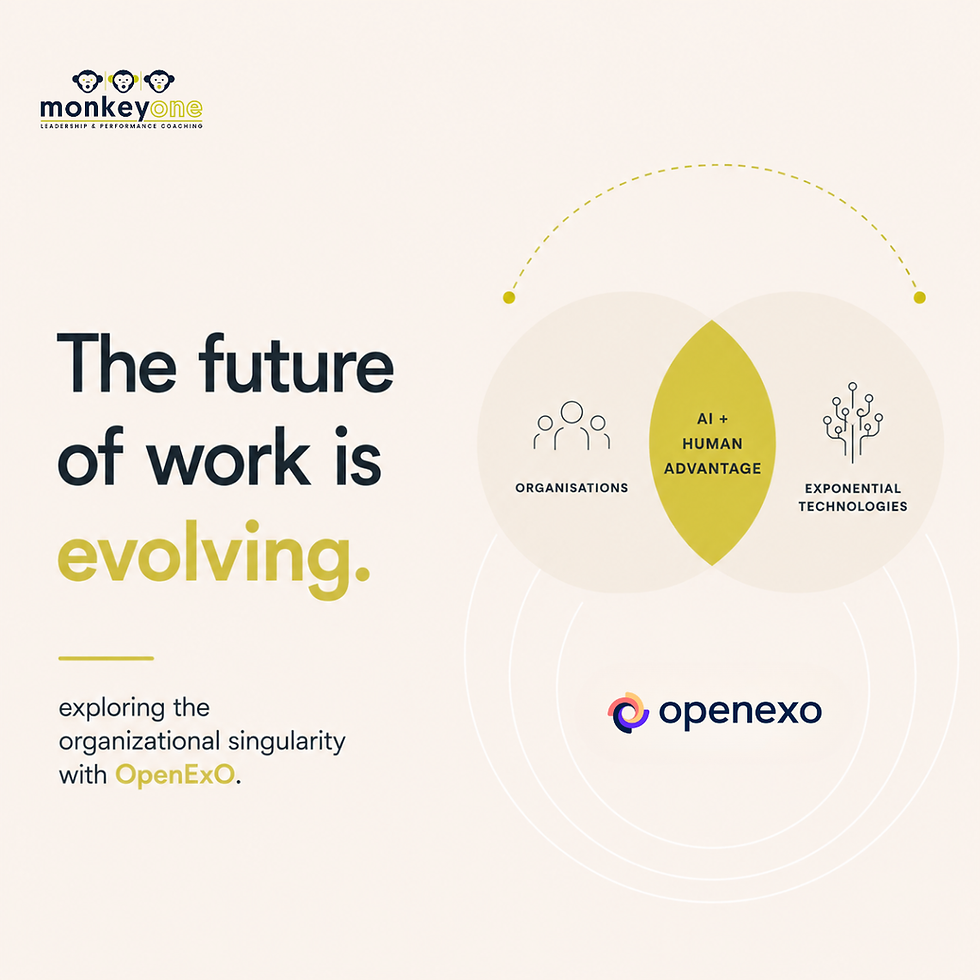
AI + Human Advantage — learning how to work alongside evolving technology in ways that support clearer thinking, better decisions, and stronger performance.
Because leadership, performance, and adaptation are not separate conversations.
They influence one another.
And often, progress starts with becoming more aware of what is already shaping how we think, lead, and operate.
Perhaps the better question is:
What patterns are influencing how you lead, perform, and adapt — without you fully noticing them?


Comments