
AI Is Not Replacing Human Performance

One of the biggest misconceptions around AI is that it is only valuable for technical industries or highly specialised roles.
For many people, AI still feels distant — something designed for developers, analysts, or large technology companies. But in reality, some of the most valuable uses of AI are much simpler and far more practical within everyday working environments.
Used intentionally, AI can support the way people think, communicate, organise, and operate day-to-day.
And that is where its real advantage often begins.
AI Is Creating Space, Not Just Speed
A lot of the conversation around AI focuses on productivity and efficiency.
Faster outputs.Faster research.Faster communication.
While speed is certainly part of the benefit, it is not the most important part.
The bigger advantage is creating mental space.
AI can help reduce time spent on repetitive low-value tasks such as rewriting content, organising information, preparing meeting structures, summarising notes, generating ideas, or simplifying complex information.
When those tasks require less mental energy, people gain more capacity for the work that actually depends on human input:
decision-making,
leadership,
creativity,
communication,
awareness,
and strategic thinking.
The goal is not simply to do more.
It is to think more clearly while doing what matters most.
Human Performance Still Drives Results
There is often unnecessary fear around the idea that AI will replace people entirely.
But technology alone does not create strong leadership, meaningful communication, emotional awareness, or intentional decision-making.
AI can support performance. It cannot replace human judgment.
This is an important distinction.
Because the people gaining the most value from AI are not necessarily the most technical individuals. Often, they are the people learning how to integrate technology into their existing workflows in a way that supports clarity rather than overwhelm.
The real opportunity is learning how to work alongside these tools intentionally.
The Importance of Intentional Use
One of the risks with modern technology is that more tools can sometimes create more noise.
More information. More inputs. More distraction.
Without awareness, people can quickly become overloaded instead of supported.
This is why intentional use matters.
AI should not become another source of constant reaction or dependency. Instead, it should support clearer thinking, stronger organisation, and more focused ways of working.
At its best, AI helps remove unnecessary friction.
It allows people to spend less time stuck in repetitive processes and more time focusing on conversations, ideas, leadership, creativity, and performance.
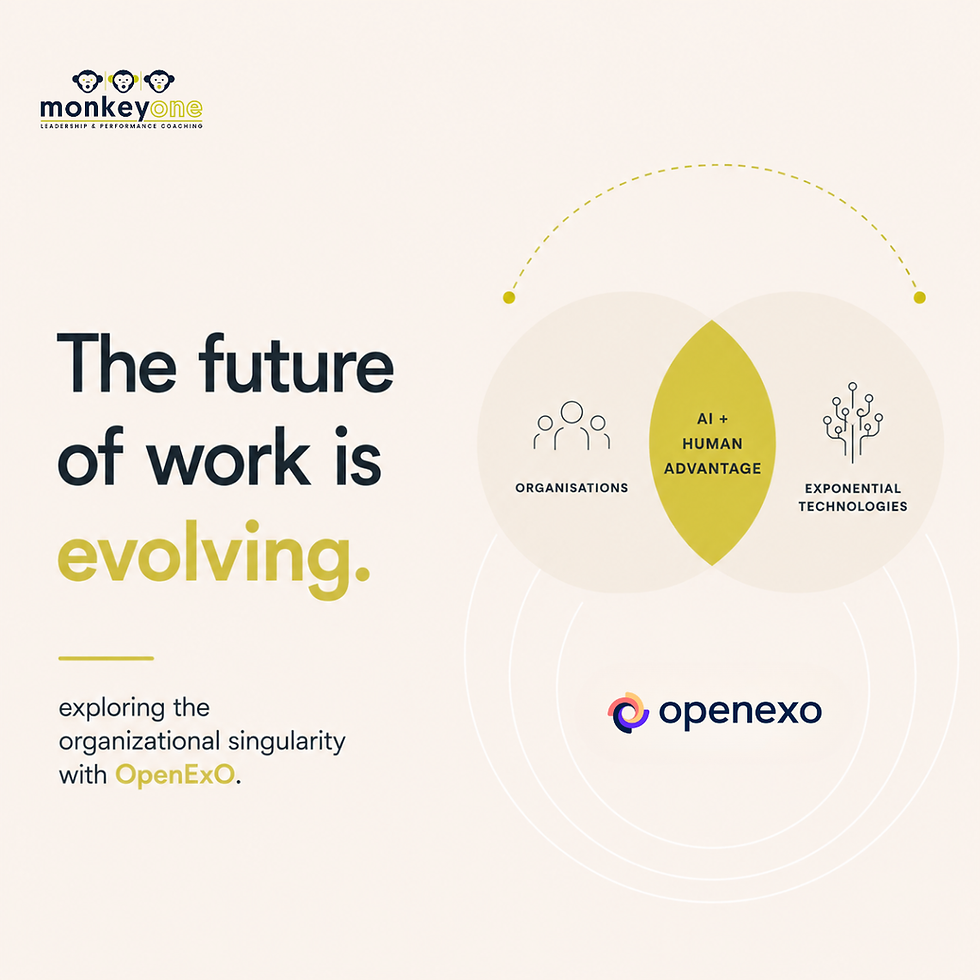
AI + Human Advantage
At Monkey One, this balance between technology and human awareness is explored through the AI + Human Advantage pillar.
The focus is not simply on using AI tools.
It is about understanding how evolving technology can support:
clearer thinking,
better communication,
stronger performance,
and more intentional ways of operating in fast-moving environments.
Because moving forward, one of the biggest advantages people can develop will not be technology alone.
It will be the ability to combine technology with awareness, clarity, and human understanding.
That is where real performance starts to separate itself.
The question is no longer: “Should we use AI?”
It is: “How do we use it in a way that genuinely improves how we think, work, and lead?”


Comments